بازدید کننده عزیز

با سلام و خیر مقدم

لطفا جهت استفاده از تمامی مطالب سایت از ارشیو مطالب و عناوین وبلاگ و جهت استفاده کامل از موضوع پست ها به ادامه مطلب  مراجعه نمایید.

همچنین توسط ایمیل mirahmadihooman@gmail.com می توانید با من در تماس باشید. 

                                  با تشکر از بازدید شما 

                                      هومن میراحمدی


                                                         *****************

متاسفانه مطالب از دی 92 تا اسفند 93به دلیل مشکل در سرورهای بلاگفا  در دسترس نمی باشد.  

Project Utopia breaks the naval architectural mould

The concept of a floating island is not new, having first surfaced in Homer's Odyssey and making countless appearances in literature from Jonathan Swift's Gulliver's Travels, C. S. Lewis' science fiction trilogy Perelandra, Hugh Lofting's The Voyages of Doctor Dolittle(1922) and the first artificially-constructed floating island makes an appearance in an 1895 novel by the father of science fiction, Frenchman Jules Verne.

Project Utopia has more in common with an oil rig than it does with a yacht, and in the word's of the consultancy, "breaks the traditional naval architectural mould which the market has come to expect and offers a truly unique outlook free from any conventional design constraints."


ادامه نوشته

Floating island yet in a fast growing market

The Wally Island was a 99 meter (325 feet) "gigayacht" design that dwarfed the vast majority of luxury megayachts and reconceived the yacht as a floating personal island, a mobile address that can be used as a home, an entertaining space or even a moving exhibition or show space.

It seems that now the naval architectural mold is broken, and has moved outside traditional areas, newer purpose-built, holistic designs have begun to emerge, most notably the work of work of Wally Yachts, Dutch Docklands Maldives and Italian industrial designer Michele Puzzolante.

The initiative is inspired by the idea of creating cities that are free from political agendas and social construction.

Now an Austrian-based company intends to manufacture much smaller, tailor made miniature floating islands, at a fraction of the cost.

Founder Gábor Orsós is aiming to combine the positive aspects of mainland real estate and luxury yachts at much reduced cost, albeit in comparison to superyachts.

Yacht Island Design's "Tropical Island Paradise", is a 90 metre island with a top speed of 15 knots

Designed in conjunction with BMT Nigel Gee, Yacht Island Design's Project Utopia measures some 330 ft (100 m) in length and breadth, spans 11 decks and has the equivalent floorspace of a present-day cruise liner - enough space to create an entire micro-nation.

The SBS2 will be able to float or submerge and as it dives, the pressure at depth against the forces of air would act like a heart and lungs, sustaining the life within the biomes. The central support biome will monitor the life systems from within its own operations facility.


http://www.gizmag.com

Green Float concept: a carbon negative city on the ocean

The idea of going offshore to satisfy our renewable energy needs isn't new, but the grand vision of Japan’s Shimizu Corporation goes way beyond harnessing green energy at sea for use in cities on Terra firma – it takes the whole city along for the ride. The company, along with the Super Collaborative Graduate School and Nomura Securities, is researching the technical issues involved in constructing its Green Float concept – a self-sufficient, carbon-negative floating city that would reside in the Equatorial Pacific Ocean.

The concept would comprise individual floating cells or districts resembling water lilies with a radius of 1km (0.62 miles) that would form a compact village that could house 10,000 to 50,000 people. Joining these districts together would form a city or module that would be home to 100,000 people, while a group of modules would form a country (though we assume there is some red tape involved before you get a seat at the U.N.).

http://www.gizmag.com

ادامه نوشته

(3D Seismic Geohazard Studies (Deep water


3D Seismic DataIn water depths greater than 200 meters, 3-D exploration seismic reflection data may be sufficient for shallow hazard assessment reporting. When previously acquired 3-D seismic data is available with sufficiently high frequency content and 100-percent coverage over the project area, shallow hazards interpretation does not require side scan sonar data. 

In such case, seafloor picks for bathymetry and seafloor amplitudes are selected by C & C geoscientists using a seismic workstation. Seabed attributes are evaluated to assess the presence of potential shallow geologic hazards and deepwater benthic communities. 

Horizons are mapped across the study area to provide details on the geologic, stratigraphic, and lithologic conditions. Assessments of shallow gas and shallow water flow are provided for each drill center as part of the well site clearance. A top-hole prognosis for each drill center is included for each well site.


Pipeline Surveys - Pipeline 4D

Pipeline 4D: a new standard in pipeline life-cycle survey management.Pipeline Survey AUV


C & C’s newest and unique AUV, the C-Surveyor VI, renders other AUVs obsolete with innovative sensing technologies for deep water pipeline inspection and survey applications. 

In addition to C & C's standard AUV sensor suite comprising a side scan sonar, multibeam echosounder, and sub-bottom profiler, C-Surveyor VI is integrated with a 3-D bathymetric laser, a camera photo mosaic system, a hydrocarbon detector, and a magnetometer.

C-Surveyor VI delivers unmatched remote sensing capabilities, including three-dimensional "point cloud” renderings of pipelines and subsea infrastructure at five-millimeter resolution, along with geo-referenced photomosaics and magnetic measurements.


ادامه نوشته

Autonomous Underwater Vehicle (AUV) Survey and Inspection


Autonomous Underwater Vehicle AUV Surveys

C & C Technologies was first to offer commercial Autonomous Underwater Vehicle (AUV) survey services to the offshore oil and gas industry. 

In 2000, C & C's clients requested help to reduce deepwater survey and inspection costs. C & C combined its extensive operational experience with lessons learned from its US Navy unmanned research programs to introduce C-Surveyor I, the world’s first commercial AUV designed for surveys for the oil and gas industry. 

As the result of C & C's expertise and vision for the survey and mapping market, cost-effective AUV surveys are now being performed routinely in a variety of worldwide offshore applications. C & C has put this AUV technology to work for more than 74 different clients in 14 different countries to date. As the energy industry has expanded its use of Autonomous Underwater Vehicles for subsea survey efforts, C & C has remained committed to leading AUV technology advancements.
 
ادامه نوشته

Intervention Tooling- Subsea inspection and integrity

The Connector Cleaner allows cleaning of connector seal surfaces while the connector is installed on a running tool. The tool uses a scissor type jacking system to access the seal surface. The cleaning module is spring loaded for uniform contact, and to limit overloading.


The Mooring Line Cleaning Tool removes marine growth without damaging the mooring line’s outer protective coating. The tool can be configured with various combinations of brushes for optimal performance. The tool is hydraulically opened and closed for the docking operation and integrated fail-safe locks keep the tool body closed during operation. The 6-wheel integrated traction system can operate the tool at any angle, while the suspension system enables the tool to handle uneven surfaces while cleaning.

The Multipurpose Cleaning Tool (MCT) consists of a brush head rotated by a hydraulic motor. The MCT uses a mild acid cleaning solution dispensed through the brush head. The MCT is equipped with a handle for ROV manipulator use.

Oceaneering

Oceaneering Will Be Recognized at OTC with Two Spotlight on New Technology Award

Oceaneering International, Inc. will be recognized at the 2015 Offshore Technology Conference (OTC) with the presentation of two Spotlight on New Technology Awards for its Deepwater Pile Dredge and Magna Subsea Inspection System™ products. The awards honor innovative technologies based on broad appeal to the industry, proven capabilities through full-scale application or successful prototype testing, and significant impact with benefits beyond existing technologies.

The Oceaneering Deepwater Pile Dredge is an electrically-driven system with pumps that provide water jetting and suction to excavate piles at any depth. The jetting provides a 360° pattern to fluidize the soil inside the pile, and then suction pumps remove the soil from the pile.

The Oceaneering Magna Subsea Inspection System is a versatile screening inspection tool that assesses the mechanical integrity of assets at a high rate of speed without disrupting production. The advanced system is ROV-deployable, inspects 360° around the pipe, and provides real-time data of the wall condition with a single deployment.

Oceaneering is one of three companies to receive multiple 2015 Spotlight awards. The Offshore Technology Conference (OTC) will take place May 4-7 in Houston, and the 2015 awards will be presented on May 4 in the NRG Center Rotunda Lobby. The Spotlight on New Technology Awards—a program for OTC exhibitors—showcase the latest and most advanced hardware and software technologies that are leading the industry into the future.

For more information, visit http://2015.otcnet.org/Content/Spotlight-on-New-Technology-Awards/.

http://www.oceaneering.com

بانک های اطلاعاتی


سایت های دانلود کتاب :

www.ketabnak.com

www.98ia.com

www.takbook.com

www.irpdf.com

www.parsbook.org

www.irebooks.com

www.farsibooks.ir

www.ketabesabz.com

www.readbook.ir

دوستان می توانند کتاب های رایگان رو از سایت های بالا دانلود کنند.

معرفی سایتهای مهم علمی،پژوهشی

بانکهای اطلاعاتی
www.digitallibraryplus.com
www.daneshyar.net
بانک های اطلاعاتی
www.umi.com/pqdauto
www.search.ebscohost.com
www.sciencedirect.com
www.emeraldinsight.com
www.online.sagepub.com
www.springerlink.com
www.scopus.com
http://apps.isiknowledge.com
پایان نامه های داخلی و خارجی
www.irandoc.ac.ir
www.umi.com/pgdauto

www.mhrn.net
www.theses.org
مقالات فارسی
www.magiran.com
www.civilica.com
www.sid.ir
کتابخانه ملی ایران، آمریکا و انگلیس
www.nlai.ir
www.loc.gov
www.bl.uk
دسترسی آزاد روانشناسی و آموزش و پرورش
http://eric.ed.gov
فهرست الفبایی مقالات، کتب و متون در زمینه حدیث، قرآن و اخلاق
www.hadith.net/new
اطلاعات عمومی کشورها
www.worldatlas.com
پایگاه اطلاعات اسلامی
www.seraj.ir
مقالات رایگان کتابداری و اطلاع رسانی
www.infolibrarian.com
آرشیو مقالات از سال ۱۹۹۸
www.findarticles.com
کتابخانه الکترونیک
www.digital.library.upenn.edu/books
رایانه و بانکهای اطلاعاتی فارس
www.srco.ir
دانشنامه آزاد اینترنتی
www.wikipedia.org
دایره المعارف بریتانیکا
www.brit
[۶/۳،‏ ۰:۰۲] ملک زاده. فرهود: sites
:دانشگاه اهايو
https://etd.ohiolink.edu/ap:1:100766165341125

florida:
http://etd.lib.fsu.edu/ETD-db/

دسترسي به متن
کامل پايان نامه هاي 435 دانشگاه
از24 کشور اروپايي
http://www.dart-europe.eu/basic-search.php

دسترسي رايگان به بانک مقالات
دانشگاه کاليفرنيا
http://escholarship.org/

دسترسي رايگان به بانک مقالات
دانشگاه TENNESSEE
http://www.lib.utk.edu:90/cgi-perl/dbBro...i?help=148

دسترسي رايگان به 1,550,632 مقاله ي
دانشگاهي
http://www.oalib.com/

دسترسي به پايان نامه هاي
الکترونيکي دانشگاه ناتينگهام
http://etheses.nottingham.ac.uk/

دسترسي رايگان به کتاب ها و ژورنال
هاي سايت In Tech
http://www.intechopen.com/

دسترسي رايگان به مقالات علمي —
دانشگاه McGillث
http://digitool.library.mcgill.ca/R

دسترسي رايگان به مقالات علمي —
مقالات 1753 ژورنال-— دانشگاه
استنفورد
http://highwire.stanford.edu/

Directory of Open Access Journals
http://www.doaj.org/

دسترسي به مقالات و متون علمي
پايگاه Proceeding of the National Academy
of Sciences 
ايالت متحده ي آمريکا
http://www.pnas.org

من اطلاعی از نام گردآورنده این اطلاعات واقعا عالی ندارم. دستشون درد نکنه

هومن میراحمدی

How Tall are the World's Largest Offshore Oil Structures

www.offshore-mag.com

Issue 6

06/09/2015

Volume 75
Issue 6
 
Issue 4

04/01/2015

Volume 75
Issue 4
 
Issue 3

03/01/2015

Volume 75
Issue 3
 
Issue 2

02/01/2015

Volume 75
Issue 2
Issue 1

01/01/2015

Volume 75
Issue 1
 
Issue 5
Volume 75
Issue 5

Assessing the state of arctic technology development

G. Abdel Ghoneim, P.E., Ph.D.
Det Norske Veritas

Sooner or later, petroleum development of the Arctic Circle will take place. The technology exists today to safely and reliably develop the 25% of world oil and gas untapped reserves that exist there. The challenges associated with the design and operation of arctic exploration and production installations are many, and have been discussed exhaustively in the past.

The goal here is to assess the current status of these challenges and to review the use of recent ice rules and standards in the design of fixed and floating arctic structures. The development of new DNV design guidelines on ice structure interaction is also discussed. That work will be completed in 2011 or early 2012. The project is based on the new ISO 19906 standard, and covers both fixed and floating installations.

Finally, a number of past and recently proposed arctic development concepts, as well as some new untested ideas, are reviewed. It is noted that some concepts may not be feasible and may carry heavy risks, while others are quite feasible but may be prohibitively expensive. Balanced concepts are sought and presented.

ادامه نوشته

Combined methodology for determination of wind and current coefficients

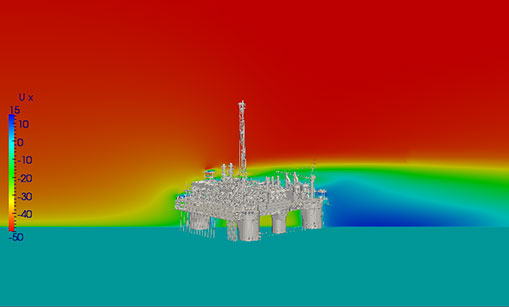
Simulation illustration: MARINTEK

The use of a CFD model validated by a short, dedicated model test campaign has become MARINTEK’s preferred approach for establishing accurate wind and current coefficients that are used in time-domain analysis of offshore structures. In addition to providing more insight into the involved physics, the validated CFD model enables us to obtain high-quality complementary data (damage conditions, alternative drafts ...) more rapidly and cheaply.

www.sintef.no

ادامه نوشته

GRAND CANCUN ECO ISLAND cleans up the ocean while generating renewable energy

grand1

Richard Moreta Castillo has envisioned a grand offshore marine platform on stilts to commemorate the 50th anniversary of beginning of Cancun’s development in 2020. Although the design for the mega Grand Cancun eco-complex will include all of the luxury amenities often associated with a project of this scale, including underwater dining and shopping galore, the project’s inspiring eco ethos is all-encompassing.

grand7

The entire surface of the offshore platform will be covered in solar panels that will provide energy for both Grand Cancun and the main city’s national grid. Vertical wind turbines and underwater tidal wave energy collectors will produce even more clean energy. A rainwater collection system allows water to be collected and then reused, which combined with a mini desalination plant will make the complex completely self-sufficient.

http://www.ortablu.org

Sea and land breeze power the eco friendly Beach Lamp concept

Designed by Zengzhu Deng the Beach Lamp aims to illuminate the beach for late night beach goers, making their beach outing a lot safer and convenient. The environmentally friendly streetlight comes with an onboard vertical axis wind energy generator that runs on land and sea breeze. 

The onboard turbine efficiently converts land and sea breeze into electricity, which is then stored in an onboard battery. After dark, the stored energy is utilized to power a set of LED lights to illuminate the beach in an environmentally friendly way. Since the streetlight incorporates a vertical axis wind generator, the concept will also be safe for birds too.

New offshore turbine design to create and store energy

New offshore turbine design to create and store energy

http://phys.org

Bermuda to Harvest Its Ocean Currents for Renewable Energy

In the first deployment of the technology rendered here, Bermuda will get its electricity from the flow of water driven by its ocean currents, tidal currents, and other coastal water flow using Submersible Power Generators.


In the first deployment of the technology rendered here, Bermuda will get its electricity from the flow of water driven by its ocean currents, tidal currents, and other coastal water flow using Submersible Power Generators.


http://www.renewableenergyworld.com

http://www.renewableenergyworld.com/rea/news/article/2006/03/bermuda-to-harvest-its-ocean-currents-for-renewable-energy-44257

Floating solar-powered Waternest eco-home is nearly 100% recyclable   

The 1000-square-foot floating pod-shaped home measures 12 meters in diameter and 4 meters tall. Its curved body is constructed from recycled glued laminated timber and a recycled aluminum hull. The rounded wooden roof is topped by a 60-square-meter photovoltaic array capable of generating 4 kWp. Four skylights flank both sides of the photovoltaic array. Large windows and balconies wrap around the unit to allow users to enjoy views of the water.

The developers created a “sophisticated system of internal natural micro-ventilation and air conditioning” to classify the building as a “low-consumption residential habitat.” The WaterNest 100 also features a flexible interior design that can be changed to suit different uses. If the owner doesn’t intend to use the unit as a home, the floating ecologicalpod could easily be reconfigured into an office space, lounge bar, restaurant, shop, or exhibition space.

Perth's Carnegie Wave Energy project

Carnegie Wave Energy, Carnegie Perth Wave Energy Project, CETO Technologies, CETO 5, HMAS Stirling, Garden Island, wave energy, hydraulic power, wave power

The Carnegie Perth Wave Energy Project is rolling out its multimillion-dollar plans to prove that waves can generate real power for the electric grid on land. Submerged in the roiling seas off the coast of Perth in Western Australia, buoy-like CETO technologies will harness energy from incoming swells and convert it into electricity and desalinated water—no greenhouse gas emissions required.

Read more: Perth's Carnegie Wave Energy project produces clean power and potable water from the motion of the ocean | Inhabitat - Sustainable Design Innovation, Eco Architecture, Green Building 

Floating Phytoplankton Farm Absorbs Carbon Dioxide and Monitors Rising Sea Levels

Bloom is a futuristic semi-submersible farm dedicated to growing phytoplankton-microscopic marine organisms that play a key role in removing carbon dioxide from the atmosphere. The farm would also monitor rising sea levels, filtrate salt water into fresh water and issue tsunami warnings. Designed by Paris-based Sitbon Architectes, Bloom was selected as one of the five finalists of the international competition Architizer A+Awards, in the category “Architecture+Weather.”


The floating spherical structure is conceived of as a way to address global warming and rising sea levels. Large phytoplankton aquariums, supervised by a permanent staff of scientists and marine experts, would be used to regulate the amount of oxygen in areas most severely impacted by global warming. Phytoplankton would absorb carbon dioxide and release oxygen through photosynthesis. The Bloom capsule will not only produce additional oxygen-it will also filter salt water into fresh water.

The capsule is attached to the seabed by a system of cables and acts as a facility for controlling water levels. Sensitive to even the smallest sea level variations, the structure would also be able to detect tsunamis and issue timely warnings.

Bloom Phytoplankton Farm, Sitbon Architectes, phytoplankton, floating building, rising sea levels, global warming, carbon dioxide, fresh water, Architizer A+Awards, carbon footprint, water issues, marine life


Oil Platforms Transformed Into Sustainable Seascrapers That Produce Clean Water

97% of water on the Earth is salt water, and only 3% is fresh water of which two thirds is frozen in glaciers or ice caps. With over 884 million people still using unsafe drinking water sources, finding a remedy to the world's water issues is a top priority. Designed by YoungWan Kim, SueHwan Kwun, JunYoung Park, JoongHa Park, this incredible concept seeks to transform the worlds off-shore oil platforms into a collection of sustainable seascrapers that will be able to produce and store fresh water straight from the ocean. The project also contains a research facility, housing pods for workers, and each platform is transformed into green spaces for recreation and evenagriculture. The team's incredible design has just received an honorable mention in the 2011 eVolo Skyscraper Competition.

The teams design provides a new use for existing drill pipes, using them to pull up water, rather than oil, to be stored in a spherical tank. The narrow and long capillary tubes have the power to raise water vertically and harnesses a natural phenomenon that doesn't require a separate energy source.


The team’s design provides a new use for existing drill pipes, using them to pull up water, rather than oil, to be stored in a spherical tank. The narrow and long capillary tubes have the power to raise water vertically and harnesses a natural phenomenon that doesn’t require a separate energy source. Amazingly, the water movement will even generate enough energythat it can be channeled and used for the site’s facilities.

After the water is drawn up it will go through a series of distillation processes, in turn producing fresh water that could later transported to countries in need. The out of commission drill points would also be used to create space for labs, lodging and management space focused on studying the marine eco-system. The concept sees the structures spread out across the ocean and to also aid in lowering the sea level and mitigating the effects of CO2 and global warming.

This clever reclamation and reuse of drill ships speaks volumes for green innovative design, first by addressing the environmental costs of oil drilling, the subsequent CO2 emissions resulting from the oil, and of course the water issues facing the world’s population today.

http://inhabitat.com

floating city

London Britannia Airport by Gensler

London Britannia Airport by Gensler

Architecture firm Gensler have released a conceptual proposal for a new floating airport for London, located in the Thames Estuary with terminals connected by underwater tunnels.

Unlike previous concepts for a new London airport, including last year's proposal by Foster + Partners, Gensler's plans do not involve pouring earth into the river for land reclamation. Instead, "we're going to float the scheme on giant platforms," explains Ian Mulcahey, the firm's global head of planning.

London Britannia Airport by Gensler

http://www.dezeen.com

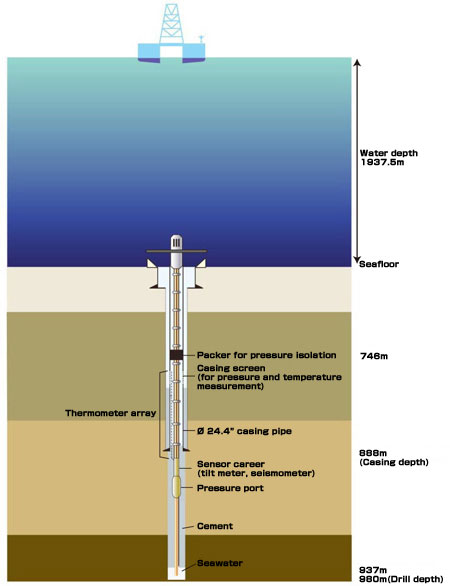
Circulation obviation retrofit kit (CORK) Schematic

Circulation obviation retrofit kit (CORK) Schematic

The Deep-Sea Drilling Vessel Chikyu, operated by the Japan Agency for Marine-Earth Science and Technology (JAMSTEC), has successfully completed Integrated Ocean Drilling Program (IODP) (*1) Expedition 332: NanTroSEIZE Stage 2: Riserless Observatory-2(*2), on 11 December in the Kumano Basin, off the Kii Peninsula. The expedition successfully deployed a long-term borehole observatory, which was developed as part of the ocean and earth exploration system, a project pursued as one of Japan’s “Key Technologies of National Importance”. Especially in event of earthquakes, the realtime near-field geophysical observations and retrieval of data will provide invaluable insights into the mechanism of great earthquakes.
for more information

Japan Agency for Marine-Earth Science and Technology

http://www.jamstec.go.jp/e/about/press_release/20101213_2

Observatory Safely Studies Deep-Sea Life

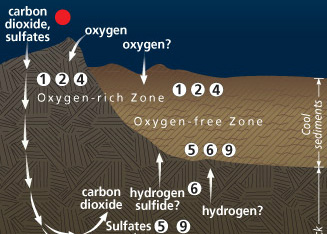
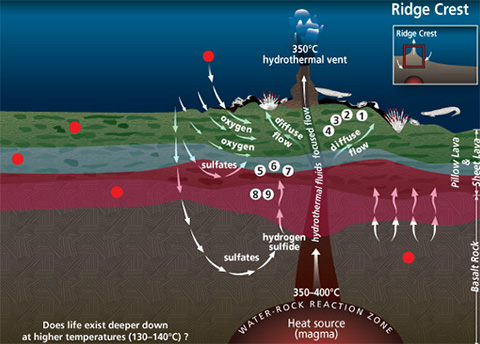
Miles below the ocean’s surface lies one of the most inhospitable habitats on the planet. Deep inside subterranean cracks, where seawater seeps through the perpetually hot rock in Earth’s crust, there’s a surprisingly rich ecosystem of microorganisms. Scientists have long been eager to study these creatures—along with the larger geological setting—but drilling holes in the seafloor large enough to drop instruments down floods the habitat with cold water and kills off the fauna. That’s where a type of rig called a Circulation Obviation Retrofit Kit, or CORK, comes in. Researchers install these observatories in boreholes, with a two-story-tall wellhead that forms a seal to protect the environment below—and a half mile or so of instrumentation

ROV PLATFORM
The CORK can be left in place for 10 years. The observatory is serviced by remotely operated vehicles, which are lowered to its 13-foot-wide platform

http://www.wired.com

http://www.whoi.edu/oceanus

A Microbial Garden Beneath the Seafloor, Pt. 3 of 3

Applied Ocean Research

http://www.sciencedirect.com/science/journal/01411187/44

Command, Control, Communications, Computers and Intelligence (C4I) Systems

Figure 1

for more information

http://www.raytheon.com/newsroom/technology_today/2012_i2/cccci.html